Listening-room acoustics at home: reflections, bass and simple treatment
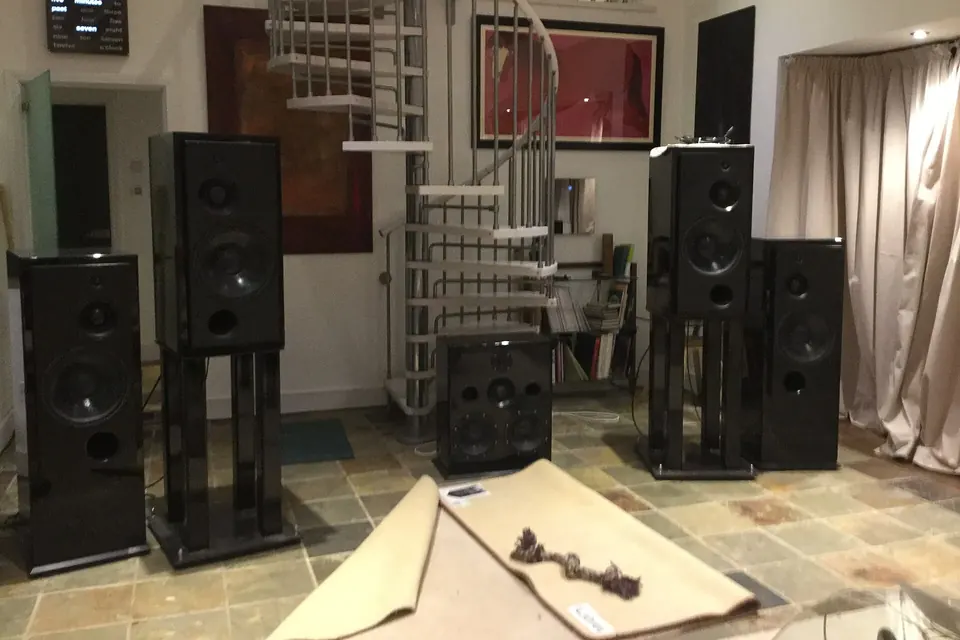
Hard floors, bare walls and big speakers: a room like this will shape the sound as much as the equipment does. Photo: c-g., Wikimedia Commons, CC BY 2.0.
Put the same pair of speakers in two different rooms and they will sound like two different pairs. Below a few hundred hertz the room dominates the bass you hear; above that, reflections from nearby surfaces colour the image and the tone. None of this needs a studio to manage. A few principles, a tape measure and some patience go a long way.
Three things the room does
Early reflections
Sound reaches you directly from each speaker, then a few milliseconds later from the nearest surfaces: the side walls, the floor, the ceiling and the wall behind the speakers. These early reflections affect how wide and how focused the stereo image seems, and can make the treble sound harsh in a hard, bare room. Some reflection is not a fault; listening research summarised by acoustician Floyd Toole suggests listeners often like a degree of lateral reflection. What matters is that it is not excessive or lopsided.
Reverberation
After the early reflections, sound keeps bouncing around the room and decays. A room with hard floors, bare walls and large windows rings on; a room full of sofas, curtains, books and rugs decays quickly. Broadcast and standards bodies that specify critical listening rooms, such as the EBU in its Tech 3276 and the ITU in Recommendation BS.1116, set limits on how long and how evenly the sound should decay. A home room does not need to meet them, but the idea carries over: a moderately damped room is easier to listen in than an echoing one.
Room modes
At low frequencies, sound wavelengths are comparable to the room's dimensions, and the room behaves like a resonator. Between any two parallel surfaces there is a series of resonant frequencies, the first at roughly the speed of sound (about 343 m/s at room temperature) divided by twice the distance between them. A room 5 metres long has its first lengthwise mode near 34 Hz, with others at multiples of that frequency. At these frequencies, bass is loud in some places and almost absent in others, and some notes boom while others disappear.
Where to sit and where to put the speakers
Positions matter more than anything else you can buy, and the basic setup in good hi-fi on a tiny budget applies here: speakers and listener in an equilateral triangle, tweeters near ear height, a slight toe-in. For the room itself:
- Avoid sitting against the back wall or exactly in the middle of the room's length. Both are typical places where bass builds up strongly or cancels. Moving the seat forwards or back by small steps and listening to a track with a steady, walking bass line is the quickest way to find a better spot.
- Symmetry side to side. Similar surroundings left and right, at least near the speakers, give a more stable centre image.
- Distance from the front wall and corners. Speakers close to a wall or in a corner produce more bass; pull them out in small steps if bass is boomy. Ports at the back of a speaker are particularly sensitive to how close the wall is.
- Different distances to each boundary. If a speaker is the same distance from the side wall, the back wall and the floor, the reflected bass from each arrives in step and the effects stack. Varying those distances evens things out.
- Short side of the room or long side? Firing along the length of a rectangular room is often the easier starting point, but try both if the furniture allows.
Treating reflections
To find the first side-wall reflection points, sit in your listening seat while a helper slides a mirror flat along the side wall: where you can see a speaker's tweeter in the mirror, sound from that speaker reflects towards you. The same trick works on the ceiling if you are curious.
- Soft furnishings first. A bookcase full of books, a thick rug between you and the speakers, heavy curtains and an upholstered sofa all absorb or scatter the higher frequencies.
- Absorbent panels at the side-wall reflection points can tighten the image in a very hard room. Thin foam tiles absorb mainly the treble, which can leave a room sounding dull but still boomy; thicker panels of mineral wool or dense fibre, spaced a little from the wall, work over a wider range.
- Do not overdo it. Covering every surface makes a room sound dead and unnatural. Treat a few key spots, listen, and stop when the sound is clear.
Taming bass
Bass problems are the hardest to fix with treatment, because absorbing low frequencies takes thick, deep materials. In a home, in rough order of cost:
- Move the seat and the speakers as above. Free, and often the biggest improvement.
- Use the bass controls or the port bungs some speakers come with, which reduce output near the wall.
- Try a second subwoofer position, if you use a subwoofer: placement changes the room's response more than the subwoofer's own settings, and a different spot along the front wall or near a corner can make a large difference.
- Room correction built into some amplifiers and receivers measures the response at the seat and applies equalisation. It can reduce peaks well; it cannot fill deep cancellations, because adding power to a frequency the room is cancelling mostly just costs amplifier headroom.
- Bass traps in corners, thick and deep enough to work at low frequencies, are the most effective treatment but take space.
Measuring, simply
You do not need to measure to improve a room, but it helps you avoid fooling yourself. A measurement microphone and free room-measurement software on a laptop can show the frequency response at your seat and how it changes as you move things. Phone apps give a rough idea at best. Change one thing at a time, and listen again before and after.
Keeping the neighbours on side
Low frequencies travel through walls and floors far more easily than voices do, so the bass that fills your room also reaches your neighbours. Keep speakers and subwoofers off the shared wall and off the floor (stands or isolating feet help), turn down the bass late at night, and, if you are choosing a home, read acoustics and sound insulation before you rent to understand how sound moves between flats.
Sources
- Floyd E. Toole, Sound Reproduction: The Acoustics and Psychoacoustics of Loudspeakers and Rooms, Routledge (Focal Press).
- International Telecommunication Union, Recommendation ITU-R BS.1116, methods for the subjective assessment of small impairments in audio systems (listening room requirements).
- European Broadcasting Union, Tech 3276: Listening conditions for the assessment of sound programme material, with supplement Tech 3276-S1.
 Rooms & neighbours
Acoustics before you rent
Street, walls, floors and windows: what to listen for at a viewing, simple tests, and fixes that need no building work.
Good hi-fi on a tiny budget
Speakers first, secondhand amplifiers, free gains from placement, and nothing spent on magic cables.
 Recording & transfer
Point-source stereo recording
Two microphones, one position: XY, ORTF, AB and Blumlein compared, with the standard angles.