Hum and buzz in a hi-fi system: tracing the source and fixing ground loops safely
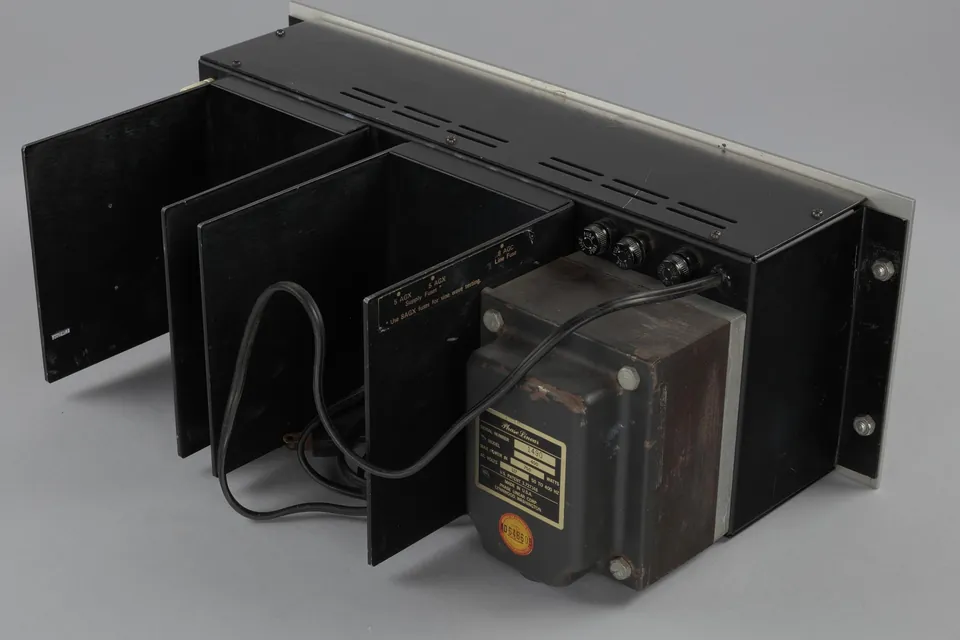
The rear of a Phase Linear 400 power amplifier from the 1970s, with a large transformer bolted on and the mains lead looping across it. Transformers and mains cables are where most hum begins. Photo: National Museum of African American History and Culture, Smithsonian, CC0.
A low drone that never goes away is one of the most common complaints about a newly assembled hi-fi, and one of the most misdiagnosed. People replace cables, buy filters and blame the amplifier they have just bought, when the cause is often the way two perfectly healthy boxes are connected. Sometimes it really is a failing part. A patient order of tests tells the two apart, usually in less than an hour, and without the one "fix" that should never be tried: disconnecting the safety earth.
Hum, buzz and hiss are different problems
Start by listening carefully, close to each speaker in turn, at a normal volume setting with nothing playing.
- Hum is a smooth, low tone at the mains frequency, 50 Hz in Europe and most of the world, 60 Hz in North America, sometimes with its double. It sounds like a deep "mmm".
- Buzz has the same basic pitch but a harsh, raspy edge, because it is rich in higher harmonics. It typically comes from switching electronics, dimmers, chargers, or from current flowing in the shield of a signal cable.
- Hiss is a broadband noise like air escaping. It is not mains-related at all, and points to noisy transistors, a high-gain stage turned up too far, or simply tape.
Also listen to the equipment itself with your ear near the case. A mechanical hum from the transformer, audible from the box but not from the speakers, is a different issue, dealt with at the end of this article.
Step one: the amplifier on its own
Switch everything off. Disconnect every source from the amplifier, leaving only the speakers attached, and unplug the aerial or any other cable going to the wall. Then switch the amplifier on and try three things:
- Select a line input with nothing plugged in, such as CD, aux or tuner, and turn the volume up and down.
- If the hum is still there with the volume at minimum, it is produced after the volume control, in the power amplifier or its supply. That is a fault in the amplifier, not a connection problem.
- If it rises with the volume, it enters before the control. Try fitting shorting plugs, RCA plugs with their pin and sleeve joined, into the selected input: an open input on a sensitive stage can pick up hum by itself.
Do not test on the phono input this way. A moving-magnet phono stage has far more gain than a line input, because a cartridge delivers only a few thousandths of a volt, so an open phono input humming loudly is normal and proves nothing.
An amplifier that hums with no sources attached and the volume down needs the bench. In vintage solid-state gear the usual suspect is the large filter capacitors of the power supply, which dry out with age, as our guide to what fails in vintage amplifiers explains. In valve amplifiers, add heater wiring, a valve with heater-to-cathode leakage and a hum-balance control that needs setting; see our article on vacuum tubes in hi-fi. Those jobs involve voltages that can kill, and capacitors that stay charged after the plug is pulled.
Step two: add sources one at a time
If the amplifier is quiet alone, reconnect the sources one by one, switching off before each connection, and listen after each. The hum usually arrives with one particular box. Note which, and whether it disappears when that source is switched off but still connected: if it stays, the problem is in the connection, not in the source's circuitry.
Move the cables while you listen. A hum that changes as a signal lead is moved closer to or further from a mains cable, a wall-wart power supply or the back of another unit is magnetic pick-up. Re-route signal cables away from mains leads and transformers, cross them at right angles where they must meet, and keep them no longer than necessary.
Ground loops: when two safe boxes make a loop
Most equipment with a three-pin plug has its metal chassis connected to the protective earth of the building, and the screen of every unbalanced RCA cable connects the chassis of one box to the next. If two units are earthed through the mains and also joined by a cable screen, a loop is formed. The changing magnetic fields around mains wiring induce a small current in that loop, and because the cable screen is also the signal's return path, part of it ends up in the music as hum or buzz. The same happens when one unit is earthed somewhere else entirely, through a different socket circuit or a coaxial aerial cable.
Typical culprits:
- The aerial or cable-TV lead on a tuner, video recorder or television connected to the hi-fi. Unplug the coaxial cable from the wall: if the hum vanishes, you have found it.
- A computer or laptop feeding the amplifier, especially while charging. This matters for anyone doing tape transfers, because the same loop puts hum into the recording.
- A turntable whose separate earth wire is missing or not attached to the amplifier's GND terminal, a case covered in our guide to reviving a vintage turntable.
- Units plugged into different wall sockets, sometimes on different circuits, across the room.
Safe fixes, in order of cost
- Plug the whole system into one socket through a single good-quality power strip, so that all earths meet at one point.
- Shorten and tidy the signal cables, and keep them away from mains leads, as above.
- Break the loop on the signal side, not the mains side. For an aerial, fit a coaxial isolator designed for that purpose. For a computer, try running the laptop on battery as a test, then use an isolated audio interface, a USB isolator or a line-level isolation transformer between source and amplifier.
- Use balanced connections where both units offer them, as professional equipment does: they reject most of the noise that the cable screen picks up.
Never cut, tape over or bypass the earth pin of a mains plug to cure hum. The earth is what keeps a metal case from becoming live if a fault develops.
"Cheater" adaptors that lift the earth do silence ground loops, and that is exactly why they are dangerous: the hum goes, and so does the protection. If a system can be made quiet only by lifting an earth, something else is wrong and should be found.
When the box itself hums
A transformer that growls mechanically, while the speakers stay quiet, is not a ground loop. Laminations can loosen with age, and some designs, toroidal transformers in particular, are sensitive to a small DC offset on the mains supply caused by other appliances in the house. Try the amplifier on another circuit or in another building: if it becomes quiet, a DC blocker made for the purpose may help. If it hums everywhere, have the transformer checked. Mounting screws can sometimes be tightened, but this is a job for someone who knows how to work safely inside mains equipment.
When to stop
Stop and take the unit to a technician if the hum is present with no inputs at all, if it is accompanied by a smell, smoke, a fuse that blows or a case that tingles to the touch, or if it began after a bang or a power cut. A tingling case in particular means current is going where it should not, and the equipment should be unplugged until it has been checked.
Sources
- Mains frequencies by country, and the origin of hum at the mains frequency and its harmonics: Wikipedia, "Mains hum".
- How ground loops form in audio systems, and isolation and balanced connections as remedies: Wikipedia, "Ground loop (electricity)".
- Phono input sensitivity compared with line inputs: the specifications pages of vintage amplifier and receiver service manuals.
 On the bench
What fails in vintage hi-fi
Capacitors, pots, relays, belts and bias, and why safety comes before any of them.
 On the bench
Reviving a vintage turntable
Belts, idlers, speed, stylus wear, tracking force and alignment: a careful order of work before the first record goes on.
 On the bench
Vacuum tubes in hi-fi
Preamp, power and rectifier tubes, matched pairs, testers, bias, and lethal voltages.