Technics turntables: the SL-1200 story, from 1972 to the MK7
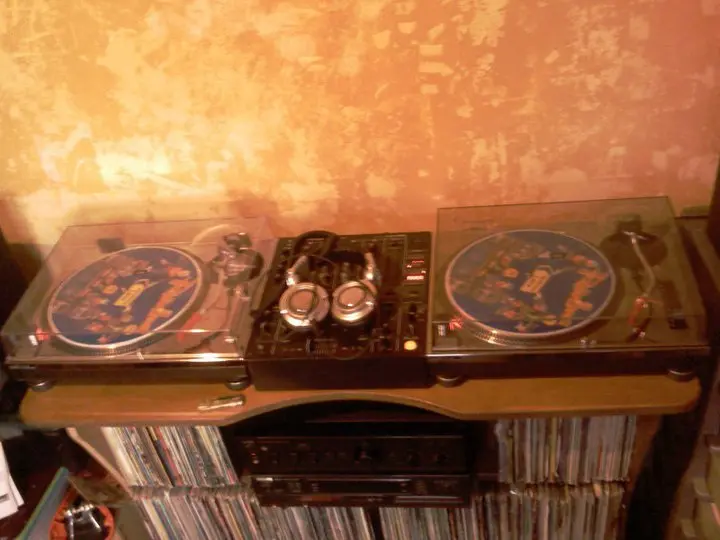
Two Technics turntables, an SL-1200MK2 and an SL-1210MK2, either side of a mixer: the layout that clubs adopted from the 1980s onwards. Photo: Jenkinslane, Wikimedia Commons (public domain).
Few pieces of hi-fi have outlived their own catalogue the way the Technics SL-1200 has. It was launched in 1972 as a compact direct-drive deck for the home, became the standard turntable of discos and clubs, sold in millions, stopped in 2010 and came back six years later. Fifty years on, Technics counts fifteen models in the series. This is the story of the maker and its machine, model by model, and what it means for anyone looking at a used one today.
Technics before the SL-1200
Technics is not a company in its own right but a brand. Matsushita Electric, the group now called Panasonic, created it in 1965 for premium loudspeakers sold in Japan, and over the following decades put the name on amplifiers, receivers, tape decks, CD players and digital pianos, as the brand's history on Wikipedia summarises.
The decisive step came in 1969 with the SP-10, based on an invention by the engineer Shuichi Obata and generally described as the first direct-drive turntable on the professional market. Instead of turning the platter through a rubber belt or an idler wheel, the motor drove the platter directly. That removed the parts that stretch, slip and wear, and gave very stable speed with strong torque. A consumer model, the SL-1100, followed in 1971, and the SL-1200 in 1972. Our profile of the makers behind classic hi-fi sets Technics alongside Nakamichi, Denon, McIntosh, Marantz and Revox.
1972: a home deck that clubs adopted
The first SL-1200 combined that direct drive with a compact body. In its own history of the series, Technics lists the features that mattered: a motor that reached full speed within half a turn, a large, heavy platter with little speed variation, and a rigid die-cast aluminium cabinet.
None of this was designed for DJs, yet each feature suited the discos then spreading from the United States. Fast start-up made cueing easy, steady rotation kept beats aligned, and the heavy cabinet resisted the vibration and feedback of a loud room. DJs also found a use the engineers had not intended: the pitch knob, meant to correct small errors in motor speed, became the tool for matching the tempo of two records.
1979: the MK2 and the DJ turntable
Technics responded with the SL-1200MK2, which the maker presents as the first turntable built around DJ use. Two changes defined it:
- Quartz lock. The speed was now controlled against a quartz reference, the method used in watches. Strictly speaking, that made a pitch control unnecessary; Technics kept one anyway, because DJs had made it essential.
- A sliding pitch fader. The rotary knob gave way to the long fader that every DJ deck since has copied, with a cabinet of die-cast aluminium on top, moulded rubber underneath and four large isolating feet for loud venues.
From this point the company itself describes the deck as moving from a record player to an instrument for playing records. The SL-1210 versions seen in many booths are the same design in a different finish and specification for other markets.
1989 to 2008: refinements, not revolutions
For three decades the series changed in details that working DJs asked for, while the core stayed the same. The milestones, all from the Technics chronology:
| Year | Model | What changed |
|---|---|---|
| 1989 | SL-1200MK3 | Japanese market; extra damping compound inside the cabinet; a slipmat in the box for the first time |
| 1995 | SL-1200LTD | Marked two million units sold worldwide; 5,000 numbered gold-plated units; first pitch reset button |
| 1997 | SL-1200MK3D | No centre click on the pitch fader, so fine adjustment around 0% became easier; headshell stand; safer power switch |
| 1997 | SL-1200MK4 | 78 rpm for shellac records, detachable phono cables, oxygen-free copper arm wiring |
| 2002 | SL-1200MK5 / MK5G | 30th anniversary; brake adjustable without removing the platter; the MK5G added a ±16% pitch range and blue lighting |
| 2004 | SL-1200GLD | Marked three million units produced |
| 2008 | SL-1200MK6 | Revised arm finish and damping; by 2007 production had reached about 3.5 million |
Technics puts the total for the series, from the first SL-1200 to the MK6, at about 3.5 million decks shipped worldwide. That volume explains why the used market is still full of them, and why spare parts, from platter mats to tonearm parts, remain easy to find.
2010: the end, and the return
Panasonic stopped making the SL-1200 in 2010, a decision Ars Technica later called "odd" for "one of the most revered and reliable" turntables ever made. Decks from the 1970s were still working, which made new ones less pressing, but online petitions asked for its return.
It came in 2016, after Panasonic relaunched the Technics name for high-end audio. As Ars Technica reported at its announcement in January 2016, the SL-1200GAE was "limited to 1200 units", to mark fifty years of the brand, with a regular SL-1200G to follow. Both were aimed at audiophiles as much as DJs.
The key change was the motor. Direct drive had always been criticised by some listeners for "cogging", small speed fluctuations caused by the iron core of the motor. The new coreless direct-drive motor removed the core altogether, and Technics paired it with a heavier, layered platter and cabinet. A simpler SL-1200GR followed in 2017.
The MK7 and today's line-up
The DJ model returned in 2019 as the SL-1200MK7. On its product page, Technics describes a coreless motor with torque matching the MK5, torque and brake speed adjustable in four steps, digital pitch control over ±8% or ±16%, and a reverse play function. The button layout and platter inertia were kept close to the old MK series, so that DJs trained on a MK2 feel at home. It weighs about 9.6 kg and was listed at $1,299.99 on the American store when we checked in November 2026.
The series reached fifty in 2022, marked by a limited SL-1200GAE-K and the SL-1200M7L, a MK7 in seven colours. Alongside them, the Grand Class and Reference Class decks carry the direct-drive design into high-end hi-fi.
Buying a used SL-1200: what to check
An old SL-1200 is robust, but clubs were hard on them. Before paying, check:
- Speed and pitch. With the pitch at 0%, the strobe dots on the platter edge should stand still under the built-in lamp. A crackling fader, or speed that jumps as you move it, means a worn pitch control.
- The tonearm. The arm should move freely, with no play in its bearings, and the height adjustment ring should turn smoothly. Bent arms are common on decks that were dropped in transit.
- The phono cables and earth lead. Before the MK4, the cables were fixed; damaged ones cause hum and dropouts (see our guide to tracing hum and buzz).
- Start-up and braking. The platter should reach speed almost instantly and stop cleanly. A slow start points to motor or electronics faults.
- The cartridge and stylus. Budget for a new stylus whatever the seller says. Our vintage turntable service guide covers tracking force, anti-skate and the phono stage, and buying used gear covers the paperwork and the questions to ask.
Model choice is mostly about use. For home listening, a well-kept MK2 or MK5 still does the job; for 78 rpm records you need a MK4 or a newer model with the speed; for the quietest motor, the post-2016 coreless decks are a different machine.
Mentioned here and want a correction or removal? Contact us.
Sources
- Technics (Panasonic), SL-1200 series history (in Japanese), model-by-model chronology from 1972 to 2022.
- Technics, Direct Drive Turntable System SL-1200MK7, product description and specifications, checked 27 November 2026.
- Mark Walton, The legendary Technics SL-1200 turntable is back and better than ever, Ars Technica, 6 January 2016.
- Wikipedia, Technics (brand), for the 1965 founding and the SP-10.
The makers behind classic hi-fi
Six manufacturers, their landmark products, and what their names mean on the used market.
 Repair bench
Reviving a vintage turntable
Belts, idlers, speed, stylus wear, tracking force and alignment: a careful order of work before the first record goes on.
Buying used vintage hi-fi
Research the model, test what you can, budget for service, and know when to walk away.