Hi-fi in a flat: why bass reaches the neighbours, and what actually keeps it in

A bookshelf speaker standing straight on a TV unit: a common set-up, and a very efficient way to turn a piece of furniture into a second loudspeaker. Photo: Roy Tanck, WordPress Photo Directory, CC0.
The neighbour downstairs rarely complains about the singer. What comes through the ceiling is a dull, rhythmic thud with no tune attached: the bass line and the kick drum, carried by the building itself. That is good news, in a way. Most of the sound that escapes a flat leaves by a few predictable routes, and the cheapest fixes address exactly those routes. The expensive-looking ones, foam tiles and egg boxes on the walls, mostly do not.
Two kinds of sound, two kinds of problem
Acousticians separate airborne sound, which travels through the air of your room and has to make a wall or floor vibrate before it can reach next door, from structure-borne sound, which is injected straight into the building through anything touching it: speaker cabinets on a floor, a subwoofer on floorboards, a turntable shelf screwed to a party wall, feet on a hard floor.
Speech and the upper range of music are mostly airborne, and a solid wall stops a good deal of them. Low frequencies behave differently. Their wavelengths are long, roughly seven metres at 50 Hz, given the speed of sound in air, so they bend around obstacles and set whole walls and floor slabs moving. Once the structure is moving, the sound can surface rooms away from the one you are in. Building acousticians call these indirect routes flanking paths: the sound goes around the wall you were relying on, through the floor, the ceiling void, the pipes or the joists it shares with the next flat.
This is also why the ratings used to describe walls can mislead music lovers. The US Sound Transmission Class, for example, is built around the frequencies of speech, and its own definition notes that it is less useful for music, which carries far more low-frequency energy. A wall that keeps a conversation private can still let a bass line straight through.
Step one: get the speakers off the structure
The single most effective change in many flats costs almost nothing. A loudspeaker cabinet vibrates as it plays; standing it directly on a floor, a sideboard or a shelf fixed to the wall hands that vibration to the building.
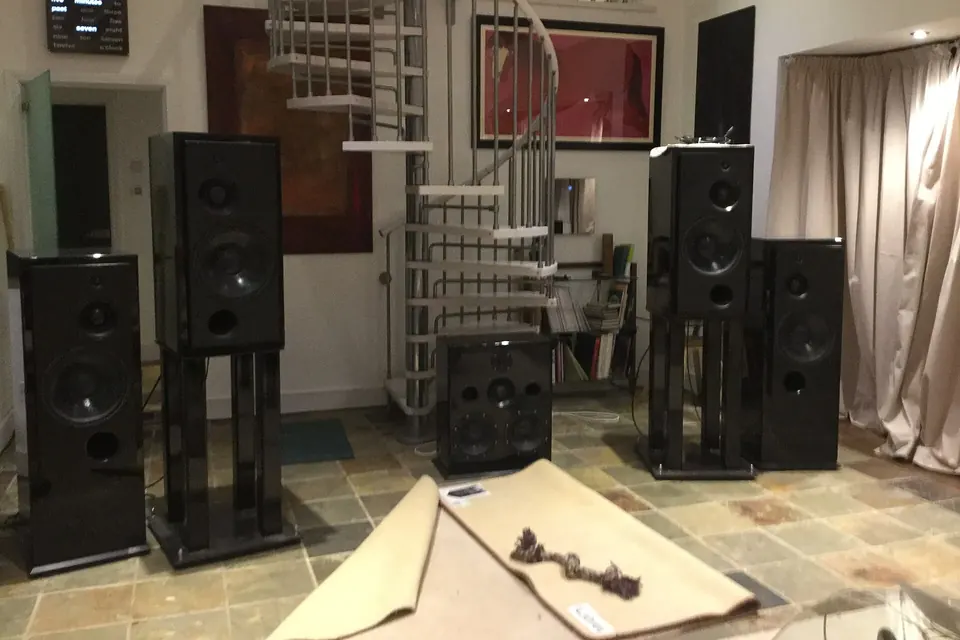
- Floor-standing speakers usually come with spikes, meant to couple them firmly to a carpeted floor. On a suspended timber floor in a flat, that coupling works against you. Soft feet, or a heavy slab of stone or wood sitting on a resilient layer, break the direct path.
- Bookshelf speakers are better on rigid stands than on furniture. A cabinet or TV unit is a large, lightly built box that resonates very willingly, as the photo above shows only too well. If they must stay on furniture, put a dense, slightly compliant pad between speaker and shelf.
- Wall brackets are the worst case for a party wall. If you use them, use them on an internal wall that belongs to your own flat.
- The subwoofer deserves the most attention, because it produces exactly the frequencies that travel furthest through a structure. Never stand it straight on floorboards above a neighbour. A heavy platform on resilient feet, sometimes sold as an isolation platform, is a sensible small purchase.
Isolation feet and platforms work by being softer than the floor, so that the cabinet's movement is absorbed in the pad instead of being passed on. Anything you put down should be stable: a tall speaker on soft feet must not rock, especially in a home with children or pets.
Step two: move things away from the shared walls
Placement matters twice: for how the room sounds, and for how much of it leaves. Our guide to listening-room acoustics explains how a speaker close to a wall or in a corner gets a strong boost in the bass. In a flat, that extra bass is also extra energy pumped into the wall behind it.
- Find out which walls are party walls, shared with another dwelling, and which are internal. A building plan, the landlord, or simply where the next front door is will tell you.
- Point the system along the length of your flat, not at the neighbour, and keep speakers some distance out from any party wall.
- Avoid the corner shared with the neighbours for the subwoofer, however tidy it looks there.
- Do not fix the turntable shelf, the speaker brackets or the TV to a party wall if another wall will do. This also helps the turntable, which is happier away from footfall, as our guide to reviving a vintage turntable explains.
Step three: turn down the part that travels
Because the bass is what leaves, the bass is what to reduce. That does not mean listening to thin music.
- Lower the subwoofer level first, or switch it off for late listening. Many systems are set up with far more sub than the room needs, simply because it was impressive in the shop.
- Use the tone control or the "loudness" button with care. The loudness switch on vintage amplifiers boosts the bass at low volume to compensate for the ear's lower sensitivity. That is the right idea at a whisper, but it adds exactly the frequencies the neighbours hear.
- Consider sealed or smaller speakers for a flat. A modest pair that does not reach the lowest octave can be a deliberate choice rather than a compromise, as our article on good hi-fi on a tiny budget argues for small rooms in general.
- Use headphones for the loud late-night session. No stand or pad will make a party at full volume neighbourly at two in the morning.
What does not work, or works less than you think
Acoustic foam and egg boxes on the walls. Foam is an absorber: it soaks up reflections inside the room and can make the room sound clearer. It is far too light to stop sound going through a wall, and it does almost nothing at bass frequencies. Egg boxes do even less. Blocking sound between dwellings needs mass, airtightness and structural separation, which is building work, not decoration.
Heavy curtains and rugs are worth having for the room's sound, and a thick rug with an underlay does reduce footfall noise for the flat below. They will not contain a bass line.
Gaps are the exception. Sound in the mid and upper range leaks through any airgap: a door with a gap at the bottom, an unsealed letterbox, a hole where a cable runs through a wall. A door seal or draught excluder is cheap and does help with the airborne part.
Talk before anyone has to complain
The kindest step is also the most effective one. Ask the neighbours, once you have set things up, whether they can hear your system and when it bothers them. Play something with a strong bass line while one of you listens from their side, then try the fixes above and listen again. People are far more tolerant of noise from someone who has asked, and you learn exactly which routes your building uses. If you are still choosing a flat, our checklist for judging acoustics before you rent helps you spot a lightly built floor before you sign.
Noise rules differ from one country, city and building to the next, as do the quiet hours written into leases and building regulations. Check the ones that apply to you; the practical aim is the same everywhere: keep the music in your rooms and the bass off the structure.
Sources
- Indirect sound paths through floors, ceilings, pipes and shared structure in apartment buildings: Wikipedia, "Flanking transmission".
- What wall ratings measure, and why a speech-based rating says little about music with strong low frequencies: Wikipedia, "Sound transmission class".
- Wavelength at 50 Hz: calculated from the speed of sound in air at room temperature, about 343 metres per second.
 Rooms & neighbours
Acoustics before you rent
Street, walls, floors and windows: what to listen for at a viewing, simple tests, and fixes that need no building work.
 Rooms & neighbours
Listening-room acoustics
Reflections, room modes and bass, where to sit, and treatment that does not take over the room.
Good hi-fi on a tiny budget
Speakers first, secondhand amplifiers, free gains from placement, and nothing spent on magic cables.